High-Temperature Furnace-Wall Camera and Pinhole LensFurnace Camera and Lens
MIT7300-TXN
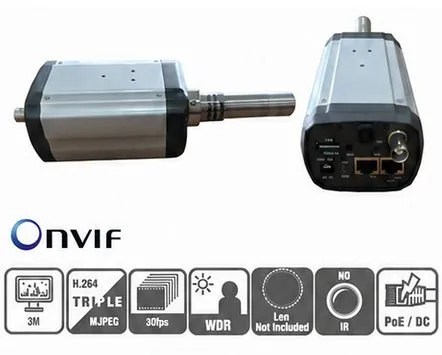
Key Features
3.21 MP progressive-scan CMOS sensor; 3-megapixel imaging (source sensor format: 1 2/8-inch; confirm with manufacturer)
Maximum 30 fps at 3 MP (2048 × 1536)
Triple stream (H.264, M-JPEG)
WDR (>100dB), Dynamic adjusting
Onboard recording to microSD / SDHC card
ONVIF (Profile S) standard
| Camera | |
|---|---|
| Image Sensor | 1/2.8” 3.21M Progressive Scan CMOS |
| Lens | 2.8~20mm optional |
| Min. Illumination | Color: 0.05 lux, B&W: 0.0005 lux |
| Video | |
| Streaming | Triple Streaming |
| Compression | H.264, M-JPEG |
| Resolution | 2048x1536, 1920x1080, 1280x720, 704x480, 640x352, 320x176, 160x96 |
| Max. Frame Rate | 30fps, 25fps |
| Bit Rate Control | VBR, CBR (H.264 only, 32K~12Mbps) |
| Frequency Control | 60hz, 50hz |
| Buffer | Max. 5.6Mbyte pre/post alarm buffer |
| Privacy Masking | 8 privacy zone |
| Motion Detection | On (144 block selection), Off |
| Enhancement | WDR (1~50, Off) |
| Day & Night | TDN (Auto, B&W, Off) |
| White Balance | Auto |
| Noise Filter | 2DNR (On, Off), 3DNR (On, Off) |
| Image Adjustment | Hue, Saturation, Brightness, Contrast |
| Sharpness | Level 0~5 |
| Automatic Gain Control | Level 1~120 |
| Shutter Speed | Auto, Manual (1/30~1/24000) |
| Sense-up | Level 0~5 |
| Flip | Vertical (On, Off), Horizontal (On, Off) |
| PTZ | - |
| Interface | |
| Video Out | 1 analog out |
| Audio In/Out | 2 way (1 in, 1 out) |
| Audio Compression | G.711, AAC |
| Alarm In/Out | 1 DI, 1 DO |
| Serial Port | RS-232C, RS-485 |
| Peripherals | 1 USB 2.0 |
| Memory Slot | 1 Micro SD/SDHC |
| Hardware | |
| System | 32bit Embedded Linux, 256Mbyte SDRAM, 128Mbyte NAND Flash |
| Approvals | KC/FCC/CE, RoHS |
| Working Condition | <350°C |
At a Glance
Operating Environment
High-temperature, hazardous, dusty or continuous-process environments requiring remote visual monitoring.
Key Benefits
Improve process visibility, reduce personnel exposure and relay anomaly information to the monitoring center.
Integration Options
Networks, alarms, thermal imaging, AI vision and centralized monitoring can be configured to suit project requirements.
Engineering Requirements
| Requirement | Information to Provide |
|---|---|
| Operating Temperature | Normal and maximum temperatures, and measurement locations |
| Installation Location | Inside the furnace, at the furnace wall, outside equipment, on piping or elsewhere |
| Imaging Requirements | Visible-light color, thermal, fixed, pan-tilt, 360° or mobile imaging |
| Communications | Ethernet, 4G / Wi-Fi or integration with an existing monitoring system |
| Certification Requirements | Explosion protection, ingress protection or other site-specific requirements |
Next Steps
Describe Your Site ConditionsNo model selection required
Initial Engineering ReviewConfirm the appropriate system architecture
Solution & QuotationRecommendations based on specifications
Project ImplementationInstallation, testing and integration
Need Help Selecting a Solution?
Share the operating temperature, viewing distance, site photos, equipment application and requirements for an initial assessment.