High-Temperatur Kamera SystemsHigh-Temperatur Kamera System
HD-SDI Full HD/300M/500M/4K
Double-wall stainless-steel housing. Kühlung air exits at the front to form a dust-protective air curtain over the lens. Suitable for ambient temperatures up to 500°C under the specified Kühlung conditions.
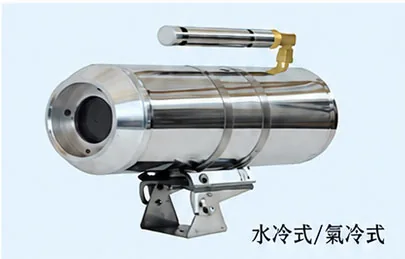
Double layer stainless steel housing for air Kühlung.
Kühlung Kamera bellow 40°C.
Motorized auto focus.
PoE—Power Over Ethernet Route From NVR.
Temperatur detector on Kamera, display on screen,
alarm output to buzzer. (Optional)
Resistant to ambient Temperatur over 500 °C.
Hochdruck air emission from front window becoming
air curtain to clear lens.
An air or water heat exchanger can reduce Kamera Temperatur below 45°C.
The Kamera connects directly to the video / network power-supply system.
With an HD-SDI Full HD Kamera, existing cabling can be retained
Optional Temperatur sensor with en temps réel on-screen Temperatur display and Temperatur alarm.
| Kamera | |
|---|---|
| Capteur d’image | 1/2.8”3.21M Progressive Scan CMOS |
| Objectif | 2.8 ~ 12.0mm (F1.2) motorized, auto IRIS |
| Éclairement minimal | Color: 0.05 lux, B&W: 0 lux |
| IR | 42 IR LED |
| PoE | IEEE 802.3af |
| Vidéo | |
| Diffusion en continu | Triple flux vidéo |
| Compression | H.264, M-JPEG |
| Résolution | 2048x1536, 1920x1080, 1280x720, 704x480, 640x352, 320x176, 160x96 |
| Fréquence d’images maximale | 30fps, 25fps |
| Contrôle du débit binaire | VBR, CBR (H.264 only, 32K~12Mbps) |
| Contrôle de fréquence | 60hz, 50hz |
| Mémoire tampon | Max. 5.6Mbyte pre/post alarm buffer |
| Masquage de confidentialité | 8 privacy zone |
| Erkennung de mouvement | On (144 block selection), Off |
| Videoanalyse | - |
| Stabilizer | - |
| Amélioration de l’image | WDR (1~50, Off) |
| Jour et nuit | TDN (Auto, B&W, Off) |
| Balance des blancs | Auto |
| Filtre de bruit | 2DNR (On, Off), 3DNR (On, Off) |
| Réglage de l’image | Hue, Saturation, Brightness, Contrast |
| Netteté | Level 0~5 |
| Contrôle automatique du gain | Level 1~120 |
| Vitesse d’obturation | Auto, Manual (1/30~1/24000) |
| Sense-up | Level 0~5 |
| Retournement | Vertical (On, Off), Horizontal (On, Off) |
| PTZ | - |
| Interface | |
| Videoausgang | -1 analog out |
| Audio In/Out | -2 way (1in, 1out) |
| Audio Compression | -G.711 |
| Alarm In/Out | -1DI, 1DO |
| Port série | -RS-232C, RS-485 |
| Peripherals | -1USB2.0 |
| Emplacement mémoire | -2 Micro SD/SDHC |
| Réseau | |
| LAN | 10/100-base-T (auto sensing) |
| Protocole | HTTP, RTSP(RTSP/UniMulticast), TCP/IP(v4/v6), UDP, FTP, Telnet, HTTPS, RARP, PPPOE, SNMP, PAP, CHAP, DHCP, NTP, SMTP client, uPnP & etc |
| Standard | ONVIF (Profile S) |
| Viewer | Browsers (IE, Chrome, Firefox, Safari etc) Quick Time, VLC |
| Dynamic IP | DDNS (www.ipctvdns.com) |
| Intelligente Lösung | IPCAM(VISION (iOS, Android) |
| Sicherheit | HTTPS, Encrypted & Basic Authentication |
| Matériel | |
| System | 32bit Embedded Linux, 256Mbyte SDRAM, 128Mbyte NAND Flash |
| Homologations | KCI/FCC/CE, RoHS, IP66 |
Auf einen Blick
Betriebsumgebung
Heiße, gefährliche oder staubige Umgebungen und kontinuierliche Prozesse, die eine visuelle Fernüberwachung benötigen.
Wichtigste Vorteile
Verbessern Sie die Prozessübersicht, reduzieren Sie die Gefährdung von Mitarbeitenden und melden Sie Abweichungen an die Leitstelle.
Integrationsmöglichkeiten
Netzwerke, Alarme, Thermografie, KI-Bildverarbeitung und zentrale Überwachung lassen sich projektbezogen konfigurieren.
Technische Anforderungen
| Anforderung | Benötigte Angaben |
|---|---|
| Betriebstemperatur | Normal- und Maximaltemperaturen sowie Messpunkte |
| Installationsort | Im Ofen, an der Ofenwand, außerhalb von Anlagen, an Leitungen oder an anderen Stellen |
| Anforderungen an die Bildgebung | Sichtbare Farbbilder, Wärmebilder, feststehend, schwenkbar, 360° oder mobil |
| Kommunikation | Ethernet, 4G/WLAN oder Integration in vorhandene Überwachungssysteme |
| Zertifizierungsanforderungen | Explosionsschutz, IP-Schutzart oder weitere standortspezifische Anforderungen |
Nächste Schritte
Benötigen Sie Hilfe bei der Auswahl einer Lösung?
Indiquez la température de fonctionnement, la distance d’observation, les photos du site, l’application et les exigences pour une première évaluation.